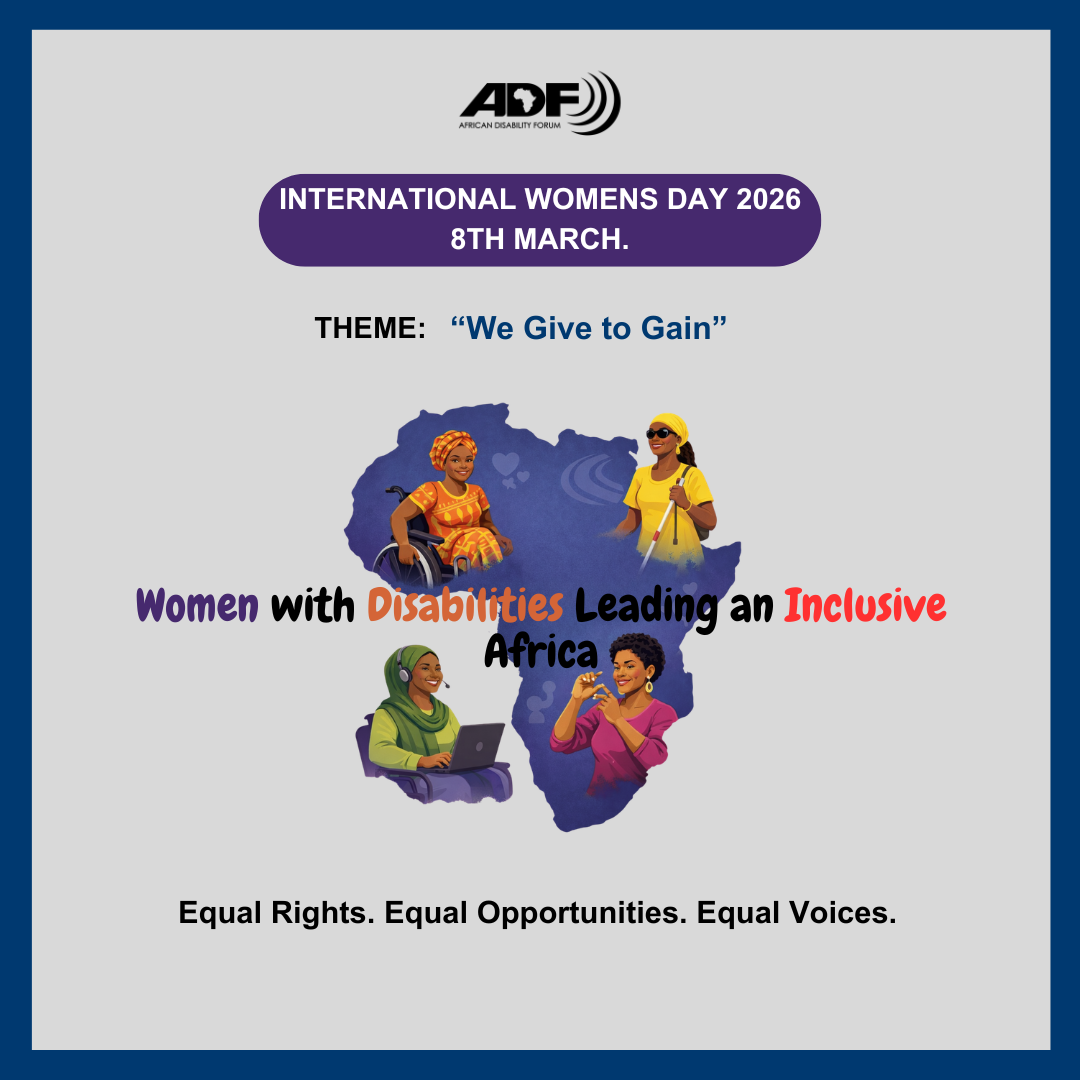
“We Give to Gain”: Empowering Women with Disabilities in Africa for International Women’s Day 2026
March 8, 2026
On this International Women’s Day 2026, the world unites under the theme “We Give to Gain.” It’s a powerful reminder that progress is not a zero-sum game. When we share knowledge, resources, and platforms, everyone rises. For women with disabilities across Africa, this message is a lived reality.
These women navigate a maze of intersecting barriers: gender discrimination, disability stigma, and systemic inequality that too often renders them invisible. Yet here is what the data reveals. When empowered, they do not just survive; they transform communities. According to UN Women, women with disabilities in developing nations face 80% higher poverty rates than their non-disabled peers, and in Africa specifically, less than 20% of girls with disabilities complete primary education compared to over 50% of their non-disabled counterparts. The loss is not just personal but societal and economic. The World Bank estimates that excluding people with disabilities costs African countries 3-7% of GDP annually.
But numbers only tell half the story.
Imagine a rural teacher in Cameroon, blind since childhood, who now trains dozens of educators to integrate assistive technology into their classrooms. Or a Kenyan activist navigating Nairobi’s uneven street in her wheelchair while rallying thousands for accessible healthcare. These aren’t exceptional cases. They’re the pulse of the Africa Disability Forum (ADF), where women lead from the front.
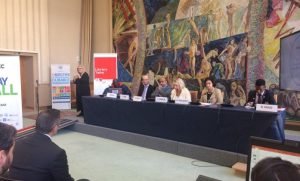
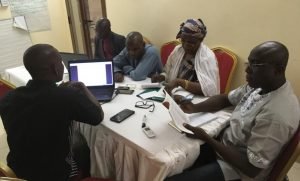
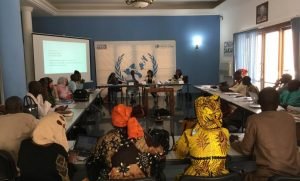
Persistent gendered barriers continue to marginalize women and girls with disabilities: patriarchal norms that silence their voices, inaccessible environments, and institutional and communication barriers that exclude them from decision-making spaces. Despite these constraints, they continue to push forward, claiming their rights and engaging in development processes. When women with disabilities mentor other women and girls with disabilities in advocacy, when they share strategies for navigating complex and exclusionary systems, and when they cultivate networks of mutual support, they are doing more than volunteering their time they are investing in a transformative multiplier effect that strengthens the collective power of women with disabilities. The African Disability Forum (ADF) has put this philosophy into action through structured mentorship programs. Women with disabilities acquire concrete skills in policy advocacy, coalition-building, and leadership gaining the confidence to claim space in decision-making processes. This is evident in the growing ranks of disabled women serving on national disability councils, shaping policies, and championing the ratification and implementation of the Protocol to the African Charter on the Rights of Persons with Disabilities in Africa (ADP).
This “giving” fundamentally shifts the narrative. It dismantles the outdated “charity model” that positions women with disabilities as passive recipients, replacing it with “rights-based empowerment”. When a woman with a disability trains her peers in digital accessibility, she builds professional authority and political visibility. When she advocates for inclusive education, she forges networks that endure beyond any single campaign. The gains multiply for her, her community, and the continent at large.
A gender lens underscores the urgency: Article 23 of the Maputo Protocol explicitly guarantees the rights of women with disabilities, yet implementation gaps across Africa. SDG 5 (gender equality) and SDG 10 (reduced inequalities) require intersectional approach, but disability is too often sidelined. Accessible skills training is not charity, it’s smart economics. International Labour Organization research shows inclusive hiring can boost revenues by up to 30%, while closing the employment gap for disabled women could inject billions into African economies.
On this 2026 International Women’s Day, the call is clear: give boldly. Mentor. Amplify. Fund. Network. Include.
Women with disabilities in Africa are building the future, one mentorship session, one policy dialogue at a time. Their full participation doesn’t just empower them; it forges societies where every woman thrives.
Today, we do not just celebrate these trailblazers. We commit to amplify the cause.
#IWD2026 #WeGiveToGain #WomenWithDisabilitiesAfrica